Premium Lounge vs Budget Rotation Club in Kabukicho — Two Nights on the Same Street, Broken Down Minute by Minute
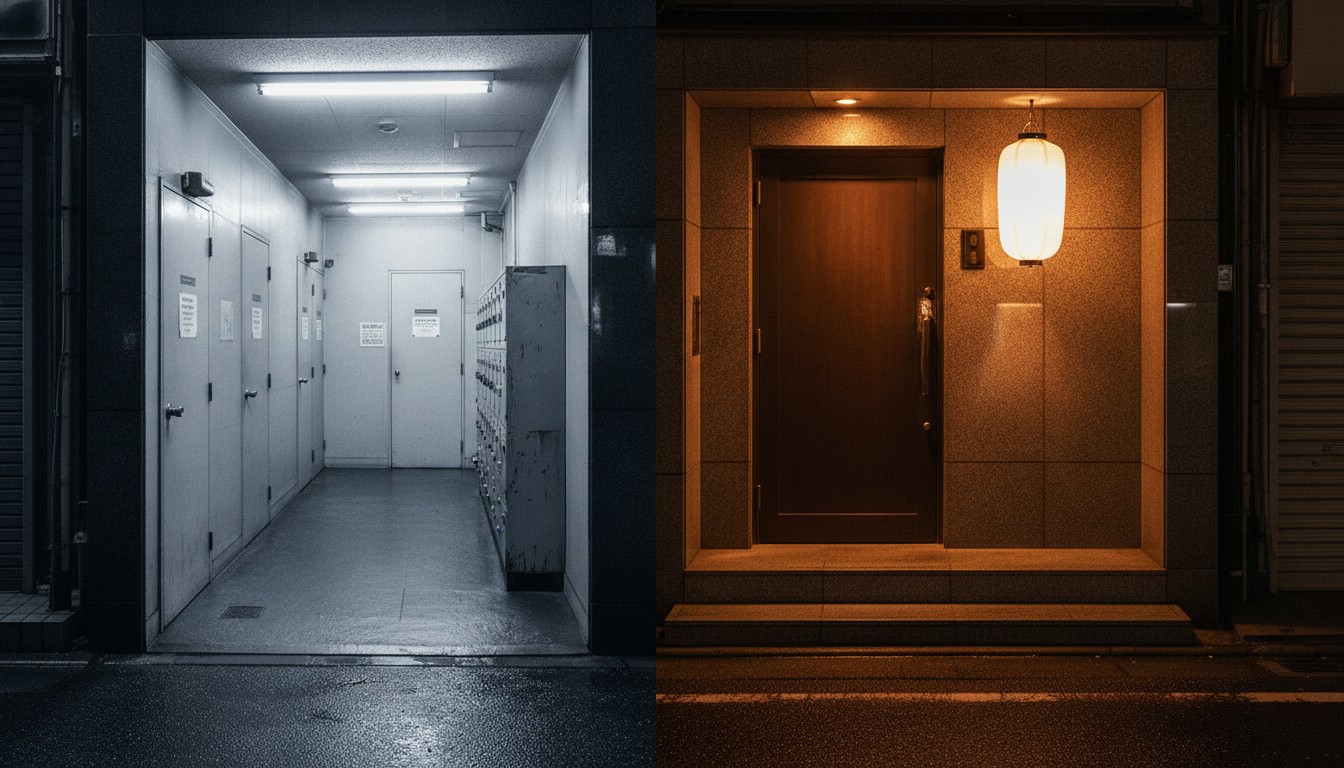
Two price signs, two architectures for the same evening
Walk any street in Kabukicho and you'll see both species side by side: one storefront advertising "40 minutes, ¥3,000~" and another whose entry starts at ¥7,000. Every first-timer asks the same question: what exactly is the expensive one charging for?
The usual answer — "you get what you pay for" — explains nothing. So let's do it properly: walk through one full evening in each type of venue, minute by minute, yen by yen. Because the real difference between them isn't the sofas or the drinks. It's how your time is structured — and that only becomes visible when you lay the whole night out end to end.
To be clear from the start: this is not a hit piece on budget venues. Rotation-system clubs have existed in Japan for decades, they have their own logic, and they suit a certain kind of customer perfectly well. The goal here is that you understand both evenings before you walk through either door — not at the register.
Night one: sixty minutes in a budget rotation club
Before the door: where "¥3,000" comes from
The sign price at a rotation club — "40 min ¥3,000–4,000" — is real, but it's a starting price, not a landing price. It typically excludes nomination fees, drinks, extensions, and sometimes a separate service charge. That's not a scam; it's the standard billing structure of the format. The only problem is that none of it is on the sign.
Minutes 0–20: the clock starts
Once seated, the venue's cast members rotate to your table in shifts — that's what "rotation system" means. Each shift runs roughly 15–20 minutes, and when time's up, she moves on regardless of how the conversation is going. From the operator's perspective, it's throughput: every customer meets the maximum number of faces per hour. From your side of the table, it means every conversation runs against an invisible stopwatch.
Minutes 20–40: the multiple-choice questions begin
Hit it off with someone? Keeping her at your table costs a nomination fee (typically ¥1,000–2,000). Want to stay past the 40-minute base slot? That's an extension, billed separately. Her drinks are on your tab too — and in this format, ordering the cast a drink is close to a default expectation: around ¥1,000 each, three or four per night being entirely normal.
Minute 60: the bill
So the "¥3,000 night" commonly lands like this: base slot ¥3,500 + one extension ¥3,000 + nomination ¥1,500 + three cast drinks ¥3,000 + service charge — a final bill somewhere between ¥11,000 and ¥13,000, in exchange for a conversation chopped into three or four hurried segments.
Once more: not a scam — a structure. If you're budget-first, want to meet many faces quickly, and don't mind your evening arriving pre-sliced, the format has a genuine logic. But if you believed you were buying a ¥3,000 evening, the register will teach you otherwise.
Night two: sixty minutes in a premium lounge
Before the door: the price lives on the website, not in a doorman's pitch
The premium difference starts before you leave your hotel — or your home country. At LUXE Shinjuku, the full price list is published online: entry from ¥7,000, drinks included within your slot, no separate service charge, no line items that materialize at checkout. You can compute your total from your sofa — that is what "transparent pricing" means in practice. Book online, and when you arrive your table is held and the staff know who you are and what language you speak. Why booking before you fly matters so much in Kabukicho specifically is a topic we've covered in full in how to book Kabukicho safely without a tout.
Minutes 0–30: conversation without a stopwatch
You're seated, drinks arrive, a cast member joins you — and then nothing interrupts. No fifteen-minute rotation pulling her away mid-sentence, no nomination-fee decision ticking in your ear. English and Chinese-speaking staff mean the conversation actually works. This is where what a premium lounge really sells comes into focus: not fancier sofas — uninterrupted time.
Minutes 30–60: what depth feels like
Because the hour is whole, this half is the actual product: conversation that develops, hospitality that doesn't rush you, and the distinct feeling of having been properly hosted. First visit and unsure of the etiquette? The how-to-play guide covers the entire flow in five minutes, and the FAQ answers dress code, language, and payment. For the cultural background of this venue category, start with what is an oppai bar.
The bill: identical to the number you computed three days ago
The bill is the number on the website. No surprises — the most expensive and cheapest service a premium venue offers.
The two bills, side by side
An ordinary evening, honestly accounted:
- Budget rotation club: ¥3,000 on the sign → ¥11,000–13,000 actually paid. Your time arrives in three or four 15–20 minute slices, each under clock pressure. Best for: budget-first visitors, variety seekers, and the "just want to see this world once" crowd — provided you walk in expecting the real number.
- Premium lounge: from ¥7,000 on the website → you pay the plan price. Whole, unhurried time; language support; pace set by you. Best for: travelers for whom the night is the itinerary, who value conversation quality, and who hate register surprises.
Notice what happened: the two final bills are far closer than the two signs — but they buy structurally different evenings. This is why value-for-money threads in travel forums so often reach the counterintuitive verdict that the "expensive" venue is the better deal. We run the full arithmetic in is a ¥7,000 Shinjuku night worth it.
One more variable that matters specifically to foreign visitors: not every venue serves non-Japanese customers. Budget rotation clubs run on domestic regulars, and the experience degrades further when language fails. How to identify genuinely foreigner-friendly venues is covered in our foreigner-friendly vs Japanese-only comparison — and reading the complete Shinjuku nightlife guide before you fly eliminates ninety percent of the ways this night can go wrong.
Reading the street: how to tell which type you're standing in front of
Kabukicho doesn't label its venues "budget rotation" and "premium lounge," so here's the field guide. Three signals sort almost every storefront in under thirty seconds.
Signal one: where the price lives. A premium venue publishes its full pricing online, findable before you ever reach Japan. A rotation club advertises a teaser number on the street sign and keeps the rest — nominations, extensions, cast drinks, service charge — for after you've sat down. If you can't compute your total from your phone on the sidewalk, assume the sign price is a floor, not a forecast.
Signal two: how the venue acquires you. Premium lounges take reservations; their tables are filled by people who decided to come. Venues that depend on street touts and "free guide" storefronts fill seats by intercepting the undecided — and a venue that pays commission to the person who walked you in has to recover that commission from your bill. The correlation between "recruited on the street" and "surprised at the register" is the single most reliable rule in the district.
Signal three: whether they're ready for you specifically. Check for an English or Chinese website, multilingual staff, and reviews written by foreign visitors. A venue built on domestic regulars isn't hostile, but nothing about its evening — the pacing, the billing conventions, the conversation — is designed to work without Japanese. A venue that invested in your language did so because it actually intends to host you.
Run all three checks and the street resolves into two clear categories — which is the entire point of this article. The type you choose is preference; walking in blind is the only actual mistake.
So which night is yours?
The honest answer: it depends on what this evening is for.
If it's a curiosity line-item on a packed itinerary — a peek into a famous subculture at the lowest possible entry fee — the rotation club delivers exactly that, as long as you walk in knowing the landing price is three to four times the sign.
But if the night itself is the destination — the evening in Tokyo you'll actually remember and retell — then the premium lounge is engineered for precisely that: whole time, a transparent bill, hosts who speak your language, and a brain free to enjoy itself instead of running a fee calculator.
Book an evening with no stopwatch on it
In Kabukicho, the most expensive price is never the one published on a website — it's the one you learn after you've sat down.
Book LUXE Shinjuku online — entry from ¥7,000, drinks included, transparent pricing, English and Chinese-speaking staff, and a 4.8-star Google rating with 310+ public reviews. Your evening deserves to be experienced whole, not billed in fifteen-minute slices.