What Is an Oppai Bar? A Foreigner's Honest Guide to Tokyo's Sekukyaba
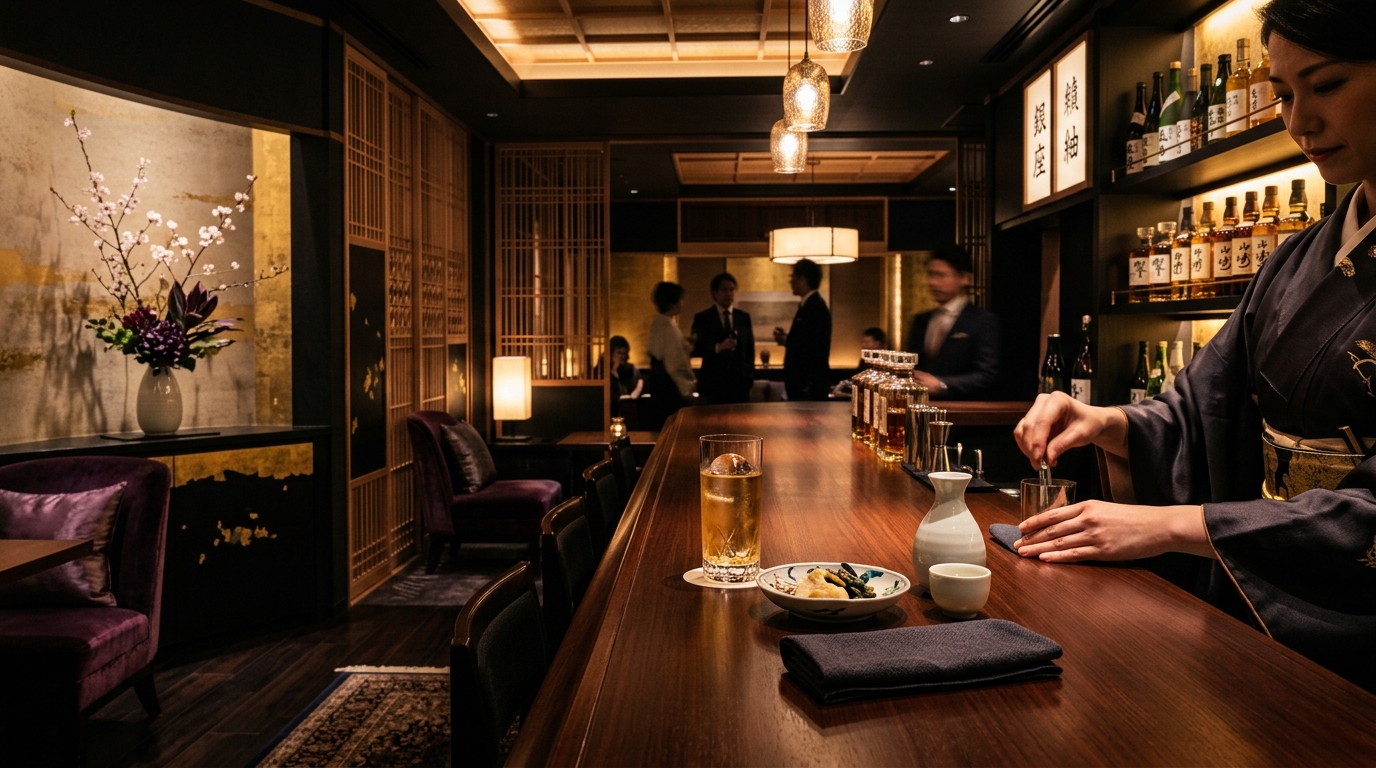
An oppai bar — written オッパイバー, known in the trade as sekukyaba (セクキャバ, "sexy kyabakura") — is a licensed Japanese hostess venue where a few hostesses take turns at your table over a timed session, the drinks are part of the price, and a limited amount of consensual contact is allowed at the table under the venue's own rules. Everything happens in the room. There's no "after", nowhere it continues to. If you've never run into the category before, that's normal: it doesn't map onto anything in Western nightlife, and even the English-language guides tend to get it wrong.
This is the long version, written for foreign visitors. What the category actually is, where it sits in Japanese law, how it differs from a kyabakura or a strip club, what a session really feels like, how the billing works (this is where people get hurt), and the handful of first-timer mistakes that cost money in Kabukicho. Skip to whatever you need.
The short answer
A few hostesses — usually two or three — rotate to your table across a 40-minute set. Premium drinks are poured as part of the price. The conversation is the point. A specific, limited kind of contact is permitted at the table, spelled out by the house, and staff hold the line on it. The word oppai (おっぱい) means breasts, and the format grew up in the late 1990s as a more hands-on cousin of the standard hostess club. That's the whole thing. If a place implies there's more — a back room, a "VIP extra", somewhere it goes after — that place is not an oppai bar, and you should leave.
Where it sits in the law (and why this matters at 1 a.m.)
This is the part most guides skip, and it's the part that actually protects you.
A legitimate oppai bar runs under the Fūeihō — Japan's Entertainment Business Law (風営法). It's licensed as settai inshoku-tō eigyō (接待飲食等営業), the same broad bucket as a kyabakura. It is not registered as a sex-industry business; legally that's a different category with different rules, and a real sekukyaba stays on the hospitality side of that line. On top of the Fūeihō licence, the venue also holds an ordinary restaurant permit from the health authority, because it serves drinks.
One practical consequence you'll notice: these venues close early. The Fūeihō caps operating hours for this category at around midnight, with 1 a.m. permitted in designated entertainment districts like Kabukicho. So when LUXE closes at 1 a.m., that isn't a lifestyle choice — it's the licence. A place running hostess service at 3 a.m. is operating outside the rules, and "outside the rules" is exactly where the problems live.
Worth knowing: Japan tightened the Fūeihō again in 2025, sharpening the conduct rules and raising the penalties. The honest read on that is simple — the licensed end of this industry is getting more regulated, not less, which is precisely why a transparent, licensed venue is the safe place to spend your first night.
How it's different from the venues people confuse it with
Foreign visitors tend to lump four very different rooms together. They aren't the same.
A kyabakura (キャバクラ) is the standard hostess club: hostesses, drinks, conversation, no contact at all. An oppai bar / sekukyaba is the same shape — rotation, drinks, conversation — with a defined, limited amount of table contact added under house rules. A hostess bar is quieter and drink-led, usually one hostess with you at a time, conversation only. A strip club is a stage show with no audience contact, a completely separate thing despite sharing the same back streets.
The differences that matter to your wallet and your evening: contact (none / limited-at-table / none / none), and how you're billed (more on that next). Everything else — the rotation, the smart-casual dress, the fact that the conversation is the actual product — is broadly shared.
At LUXE we run as a premium oppai bar, and the house rules get explained in your language at the door before you've agreed to anything. Every rate is published on the pricing page in five languages. That combination — rules upfront, prices public — is the whole test of a venue worth walking into.
What a session is actually like
You arrive. Staff check you're 20 or over (the legal floor for licensed night venues), and at a foreigner-friendly place they'll run through the system and the price in a language you read before you commit. You confirm your seat — Main Floor or the VIP Room at LUXE — and that's the moment you agree the price. Not at the end. At the start.
Then you're shown to the table and the rotation begins. Two or three hostesses come through over the 40 minutes, ten to fifteen minutes each. One pours your first drink, asks where you're from, and the conversation goes from there — where you're staying, what you've eaten, where you're headed in Japan. The rotation is deliberate: the house wants you to meet a few people so you find someone you'd come back for. You don't pick anyone at the door.
The contact rules sit on top of all that, and they're not improvised. What's allowed is allowed; what isn't is a firm no, and staff step in if a guest tests it. That rigidity is a feature — it's what keeps both the hostess and the licence safe.
Drinks keep coming as part of the price — at LUXE that's whisky, shochu, beer, soft drinks, no per-glass charge. You can buy a hostess a drink if you're enjoying yourself (¥3,000–¥10,000, entirely optional, nobody expects it). About five minutes before time, staff give you a quiet heads-up: extend another 40 minutes at the same rate, or close out. One bill at the end. At LUXE it's the number you already saw. That last sentence is the entire reason this guide exists.
The billing, plainly — because this is where Kabukicho gets you
Opaque pricing is the main way this district separates first-timers from their money. Four models you'll meet:
All-inclusive, time-based — what LUXE does. One posted rate covers the table, the rotation, the drinks, tax and service. ¥7,000 for the first-visit Main Floor (book online), ¥13,000 Main Floor after that, ¥28,000 for the VIP Room. Extensions are the same rate per 40 minutes. The only optional add-ons are nominating a specific hostess (+¥4,000) and buying her a drink. Nothing appears at the end that you didn't see at the start.
Per-head, per-hour, drinks extra — the most common Kabukicho model, and the one that surprises people. The headline number buys the seat only. Every drink (yours and the hostess's) lands on the bill separately, often ¥1,500–¥3,000 a glass. Two people, ninety minutes, the usual rotation, and you're at ¥40,000–¥80,000 before you've quite understood how.
Bottle-keep — more of a Ginza club thing: you buy a bottle that lives on a shelf with your name on it, plus table and hostess charges. Different world from the oppai-bar format.
The bottakuri (ぼったくり) trap — a tout walks you in on a low promise, the posted price is vague or missing, and the bill at the end is two or three times what you were told. It's illegal under the Fūeihō and it still happens to tourists with depressing regularity. The defence is one rule: only sit down somewhere you could read the price before you sat down. Everything else follows from that.
Is it legal, and is it safe?
Legal, yes — at a licensed venue. The category runs under the Fūeihō with a license from the Public Safety Commission, age checks at the door, sanitary standards, and inspections. A law-abiding oppai bar is an ordinary small business with a steady local clientele and a real Google Maps presence you can read before you go.
Safe is mostly about which door. Kabukicho in 2026 is more mainstream than its reputation — since Tokyu Kabukicho Tower opened in 2023 the main drag pulls a young, touristy crowd, and the well-lit spine around the Tower and Godzilla Road (the Godzilla head is the one on the Toho building) is calm enough. The risk lives in the narrow alleys and, above all, with the touts. Tokyo's 2024–25 enforcement zones on Yasukuni-dōri and Central Road thinned them out but didn't end them.
So: don't follow anyone off the street, ever. Read the 1-star Google reviews before you walk in — that's where scams confess. Book online to lock the rate. Keep your hotel address in Japanese for the taxi. And note where Kabukicho Kōban is (the police box near the south side) — the officers there deal with foreigner cases all the time. We go deeper in Is Kabukicho safe at night?.
The mistakes that cost first-timers
Following a tout. The expensive one. No venue worth your money recruits on the sidewalk. If someone's steering you, the place at the other end is either a bottakuri trap or paying a commission your bill will quietly cover. Keep walking — including if they "recommend LUXE", because we don't use them.
Sitting down before you've confirmed the number. Say it out loud: "40 minutes, drinks included, total is ¥X — yes?" If the answer wanders, or includes "depending on", you leave.
Asking for her LINE or Instagram. House rules generally forbid it and she has to say no. It puts her in a bad spot and the room notices.
Treating it like something it isn't. A hostess is a hospitality professional who chose this work. Crude propositions don't just miss — they get you walked out.
Cash only. LUXE takes Visa, Mastercard, AMEX, JCB. Plenty of places are still cash-only and a mid-session ATM run is nobody's idea of smooth. Carry both.
Why foreign guests pick LUXE
Most Tokyo oppai bars run in Japanese only, with prices that move in ways a first-timer can't predict. LUXE was built for the other case:
Everything happens in English, 日本語, 中文, 繁體中文 or 한국어, from the door. The price is all-inclusive and public — ¥7,000 first visit, ¥13,000 Main Floor, ¥28,000 VIP, tax and service already in — and it's the number on your bill. You can book online in about a minute to lock that rate; walk-ins pay the same, no penalty either way. The Google rating sits at 4.8 across 310+ reviews, most of them from foreign first-timers, all public. The VIP Room with karaoke seats up to eight and there's only one a night, so groups should book ahead. And nobody on the street works for us.
If you want the full booking-to-bill walk-through, that's How LUXE works. When you're ready, a booking takes about a minute.
A small glossary
- Oppai bar (オッパイバー) / sekukyaba (セクキャバ) — the category this guide is about
- Kyabakura (キャバクラ) — standard hostess club, no contact
- Shimei (指名) — requesting a particular hostess; honshimei is booking her ahead, jōnai-shimei (場内指名) is choosing her once you're inside
- Mama (ママ) — the floor manager, usually the most senior hostess
- Set (セット) — one billing block, 40 minutes at LUXE
- Bottakuri (ぼったくり) — the overcharging scam bar you're avoiding
- Fūeihō (風営法) — the Entertainment Business Law these venues are licensed under
- Kōban (交番) — neighbourhood police box; the Kabukicho one handles foreigner cases
- Omotenashi (おもてなし) — the hospitality instinct the whole thing runs on
The first night in Kabukicho is the one that feels uncertain. Pick a place where you can read the price and they explain the rules in your language, and there's very little left to go wrong. Book LUXE when you want to.