Is a ¥7,000 All-Inclusive Shinjuku Night Actually Worth It? My Honest CP-Value Experience
Is a ¥7,000 All-Inclusive Shinjuku Night Actually Worth It? My Honest CP-Value Experience
"Is Tokyo nightlife worth the money?" is one of the most-asked questions on PTT, Dcard, and every Chinese-language travel forum — and it is almost always answered with a shrug, a horror story, or a vague "depends." So I decided to answer it the only honest way: go, keep the receipt, and report back with numbers.
This is a cost-performance (CP-value) experience of a ¥7,000 set-price premium evening in Shinjuku. Not a price list, not a brochure — an actual account of what that money bought, where the value really sat, and how a transparent set price compares to the "cheap on the door, expensive at the end" venues that generate all the horror stories.
If you want the full price structure first, our pricing page lays it out. This article is about whether it is worth it.
The question behind the question
When people ask "is it worth it," they are rarely asking about the sticker price alone. They are really asking three things at once: Will I get gouged? Will the experience justify the spend? And will I know the total before it is too late to walk away?
That is the honest frame for judging Tokyo nightlife value for money. A ¥7,000 set price is not automatically good value, and a ¥3,000 "entry" is not automatically cheap. The number that matters is the total you actually pay, measured against what you actually get — and whether you could see that total before you committed.
What the ¥7,000 set actually included
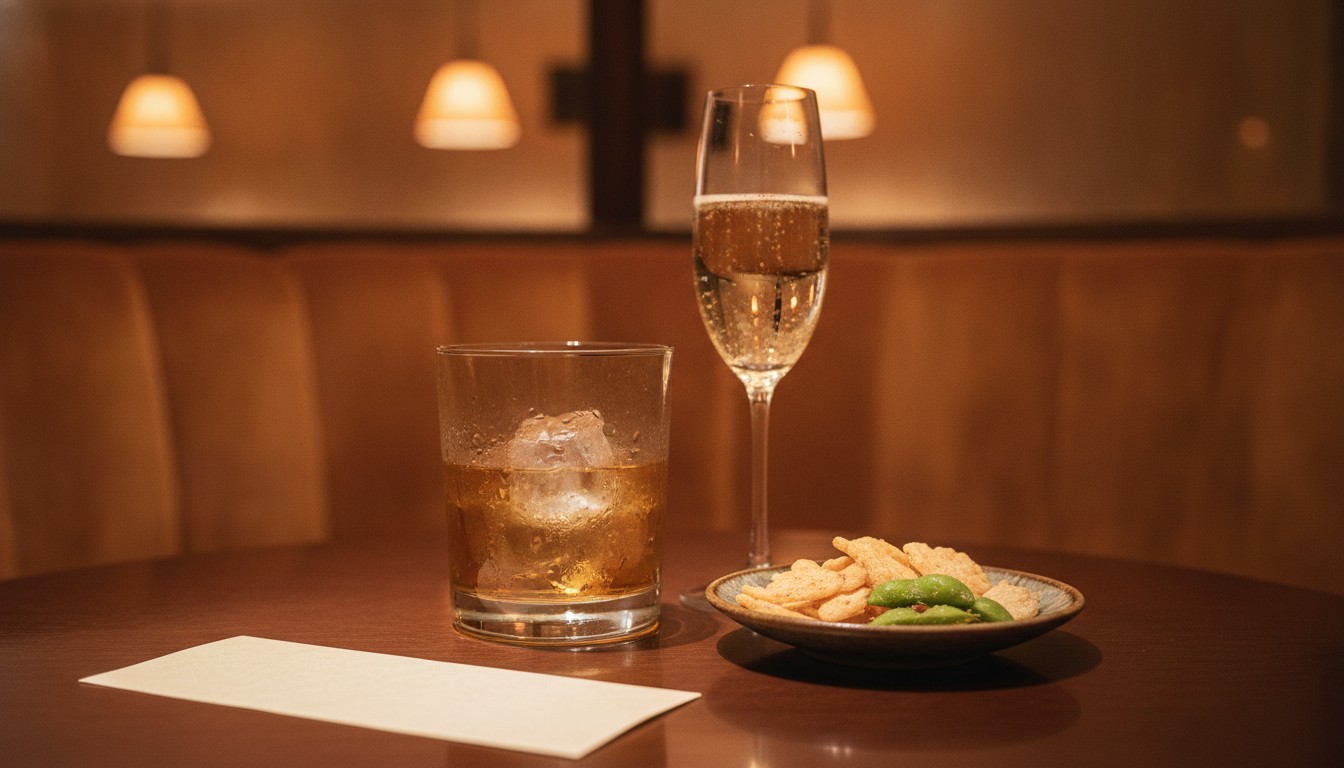
Let me start with the receipt, because that is where the horror stories usually begin and where transparency changes everything. My set covered the first hour: a seat in a calm upstairs lounge, drinks within the package terms, and conversation with a hostess. The price I booked was the price I was quoted on arrival, and the price I paid at the end. No cover charge materialized. No "table fee" appeared. No mysterious service percentage got stapled on while I was distracted.
That last part is the whole game. In hidden-cost venues, the ¥7,000-equivalent you saw advertised is a starting figure, and the real total assembles itself from set charges, nomination fees, drink markups, and an end-of-night service percentage that can quietly double the bill. The advertised number was never the real number. With a transparent set, the advertised number is the number.
8:00 PM to 9:00 PM — What that hour bought, in plain terms
So, for ¥7,000, what did I actually get? An hour of genuine, well-run social experience. A seat that felt like a private lounge rather than a crowded bar. Drinks I did not have to price-check in my head. And an hour of conversation with a hostess whose real skill — carrying a warm, funny exchange across a language gap and reading exactly how lively or laid-back I wanted the night to be — is the part that is almost impossible to put a number on but is the thing you are actually paying for.
Measured coldly, an hour of premium hospitality in central Shinjuku for ¥7,000, with zero surprise add-ons, is straightforward value. Measured by how the hour actually felt — relaxed, warm, genuinely fun — it landed well above the price. That is the honest verdict, and I am someone who came in ready to be skeptical.
Where hidden-cost venues quietly beat you
To judge CP-value fairly you have to compare against the alternative, so here is the mechanism the forums keep warning about. A hidden-cost venue advertises a low entry, then the total grows in stages you do not see coming: a set charge you were not told about, a nomination fee, drinks priced two or three times what you would expect, and a service percentage applied at the very end. Each piece sounds small; together they can turn an advertised ¥3,000–¥5,000 into a ¥20,000+ shock. We break down exactly how this works in Transparent vs. Hidden Nightlife Costs in Tokyo.
The trap is that the low number is designed to win the click and the comparison, while the real total is designed to be invisible until it is too late to leave. A transparent ¥7,000 that stays ¥7,000 will very often be cheaper than a ¥3,000 entry that ends at five figures — and it is always less stressful. That stress-versus-certainty gap is a real part of value, even if no receipt line item names it.
How the touts fit into the value question
There is one more cost the CP-value conversation usually ignores: the street. Many of the worst-value nights in Kabukicho begin with a friendly-seeming tout or a "free guide" stand steering you toward a venue that pays them a kickback — a kickback that comes straight out of your final bill. Routing around them is not just about safety; it is a direct value decision. We explain the whole dynamic in Muryo-Annaijo vs. Transparent Booking.
The practical version: the moment you book a transparent venue directly and walk past the touts, you have already removed the single biggest source of overpaying in Shinjuku. That decision is worth more to your CP-value than any drink-price haggling ever will be.
A simple way to judge value before you book
You do not need to gamble to find out whether a night is worth it. Before you book, you can settle the CP-value question with a short checklist. First, is the full price visible up front, itemized, with no "from" asterisk hiding the real total? Second, is it a set-time format, so you know what the block includes and what an extension would cost? Third, do you reach it by a confirmed reservation rather than by following someone off the street? And fourth, is the language handled — English, Mandarin, Cantonese — so you are never negotiating a bill you only half understand?
If the answer to all four is yes, a ¥7,000 set is very likely to be honest value. If any answer is no, the advertised number is probably not the real number. Our how-an-evening-works page walks through the set-time format, and the FAQ covers the cost questions guests ask most.
The honest verdict
So — is a ¥7,000 all-inclusive Shinjuku night worth it? Based on my own receipt: yes, clearly, when the price is genuinely all-inclusive and transparent. The hour delivered more warmth and fun than the number suggested, and — just as importantly — the number at the end was the number at the start. The value was not only in what I got, but in what never happened: no shock, no padding, no negotiating in a language I do not speak.
The thing to internalize is that ¥7,000 is not the point. Transparent ¥7,000 is the point. The same evening at a hidden-cost venue could have cost three times as much and felt half as good. Pay for certainty, and the night pays you back.
Frequently asked questions
How much does a premium Shinjuku evening really cost? Transparent venues typically start around ¥7,000 for a set first-hour package, with the total depending on how long you stay and what you drink. The essential point is that the full price is visible before you book — see the pricing page for the current breakdown.
Isn't a cheaper entry fee better value? Not usually. A low "entry" number is often the front of a hidden-cost structure where set charges, nomination fees, drink markups, and an end-of-night service percentage build the real total. A transparent set that stays fixed frequently ends up cheaper than a cheap-looking entry.
Can I know the total before I commit? Yes, at a transparent venue. The set price is confirmed at booking and again on arrival, and any extension is quoted before you agree to it. That certainty is a core part of the value.
Is ¥7,000 all-inclusive realistic, or a teaser? At a transparent venue it is a real, itemized set — not a teaser. The way to tell the difference is the four-point checklist above: visible full price, set-time format, confirmed reservation, and language support.
Ready to see the value for yourself?
The best money-saving decision in Shinjuku is made before you leave your hotel: book a transparent, set-price venue and walk past everything else.
Reserve your evening at LUXE Shinjuku →
Explore more before you go:
- Transparent pricing
- How an evening works
- Transparent vs. hidden nightlife costs
- How to spot Kabukicho scams
- The Shinjuku nightlife guide for foreigners
- FAQ for international visitors
"Worth it" is not a matter of luck. Make the price transparent before you go, and the answer takes care of itself.