The Unwritten Rules — Japanese Nightlife Etiquette & Culture Explained for International Visitors (Shinjuku, 2026)
The Unwritten Rules: Japanese Nightlife Etiquette & Culture for International Visitors
The most common reason a first premium night out in Shinjuku feels awkward isn't the language — it's the grammar. Japanese nightlife runs on a set of quiet conventions that locals absorb without thinking: who sits where, when to toast, whether to tip, what "nomination" means, why the price was already decided before you walked in. Nobody hands you a rulebook, so visitors often spend the evening slightly tense, guessing. That's a shame, because once you understand the culture, the whole thing relaxes into what it's meant to be: warm, unhurried hospitality.
This guide walks through the unwritten rules behind a premium Shinjuku evening — the why as much as the what. If you want the practical, step-by-step version of a first visit, our complete Shinjuku nightlife guide for foreigners covers logistics; here we're after the culture that makes the logistics make sense.
Omotenashi: the idea underneath everything
Start with one word, because it explains most of the others: omotenashi (おもてなし). It's usually translated as "hospitality," but it's closer to wholehearted, anticipatory care given without expectation of anything extra in return. The host notices your glass is low before you do. The service is already complete in the price — there's nothing to add, nothing to negotiate. Understanding omotenashi reframes the entire evening: you are not a customer extracting a service, you are a guest being looked after. We go deeper on this in omotenashi and the premium lounge, but keep it in mind as you read the rest.
No tipping — and why trying to tip is the faux pas
Here's the rule that surprises Western visitors most: you do not tip in Japan. Not at restaurants, not in taxis, and not in a premium lounge. This isn't stinginess or an oversight — it flows directly from omotenashi. Good service is considered the baseline, already reflected in the price, so adding money on top can feel like you're implying the care needed a bribe. Staff will often chase you down to return "forgotten" cash.
For nightlife specifically, this connects to something powerful: because there's no tipping culture, a well-run venue has every reason to make its pricing transparent and complete up front. The set price is the price. When you understand that this is the cultural norm, the venues that don't follow it — the ones with mysterious "service percentages" added at closing — stand out as the exception, not the rule. That instinct is your best protection in Kabukicho, and we map the whole trap in Muryo-Annaijo vs. Transparent Booking.
Shimei: the culture of nomination
One concept that puzzles almost every newcomer is shimei (指名) — "nomination." In a hostess lounge or a sekikyaba, you can request a specific person to sit and talk with you. If you had a lovely conversation with someone last time, you can nominate them again on your next visit (honshimei), and that continuity is a real, valued part of the culture — it's how regulars build a genuine rapport over months.
For a first-timer, the etiquette is simple and low-pressure: you don't have to nominate anyone. On a first visit you'll usually just be seated with whoever is available, which is completely normal and often the most relaxed way to start. Nomination is an option for when you've found someone whose company you enjoyed, not an obligation. Knowing the word exists — and that it's about continuity and rapport, not anything transactional — takes the mystery out of it.
Kanpai and the small rituals of drinking
Japanese drinking has its own gentle choreography, and a little awareness makes you an easy, pleasant guest:
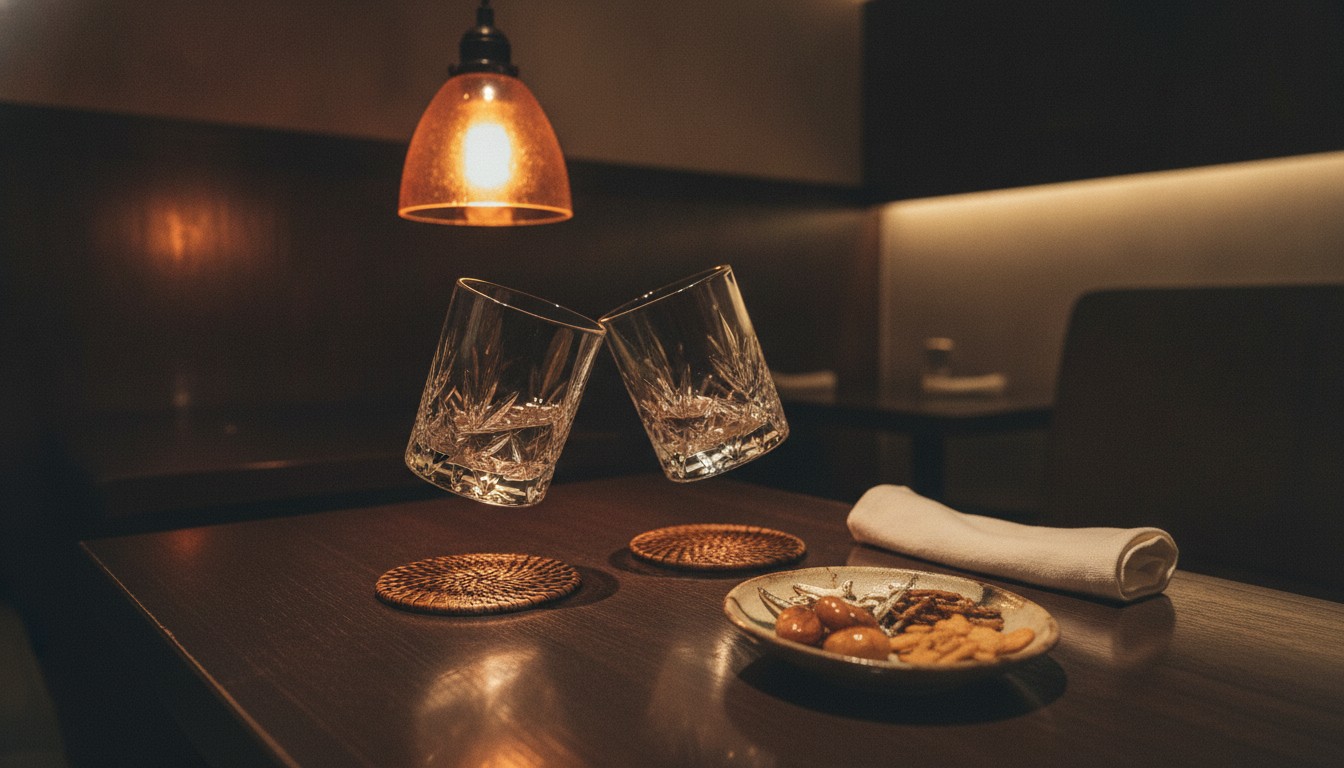
Wait for the toast. Don't drink until everyone has a glass and someone says kanpai (乾杯, "cheers"). Starting early is the small rudeness locals notice.
Pour for others, not yourself. In traditional settings, you fill your companion's glass and they fill yours; topping up your own is a subtle signal that the hospitality has lapsed. In a lounge, your host will keep your glass filled — that's part of the care — but the instinct to reach for someone else's bottle first is always well received.
Lower your glass for a senior. When clinking with someone more senior, tilt the rim of your glass slightly below theirs. It's a tiny gesture of respect that goes a long way.
Pace yourself. The goal of a premium evening is conversation and atmosphere, not volume. Drinking slowly is completely normal and nobody pushes you.
None of this is a test. Get it "wrong" and your host will simply, warmly, show you the flow. But arriving with the rhythm already in your bones makes the evening feel natural from the first minute.
Ichigo ichie: one meeting, one chance
There's a phrase from tea ceremony that quietly underlies a lot of Japanese hospitality: ichigo ichie (一期一会), "one time, one meeting." The idea is that this particular gathering — these people, this evening — will never happen in exactly this way again, so it deserves to be treated as special. It's why a good host is fully present with you rather than glancing at the clock, and it's a lovely lens to bring as a guest too. You're not just buying a couple of hours; you're sharing an evening that exists only once.
Reading the room: a few practical customs
Beyond the big ideas, a handful of small customs smooth the whole night:
Shoes and slippers. Some venues have a genkan (entrance step) where you remove your shoes. Follow the lead of the staff; if there are slippers, use them.
Cash and cards. Many premium venues now take cards, but Japan still runs on cash more than most countries. Carrying enough for the evening avoids any fumbling — and at a transparent venue you'll already know the total in advance.
Photos. Ask before photographing staff or other guests. Privacy is taken seriously, and many venues have a clear no-photos-of-people policy. A quick check is always appreciated.
Volume and space. Even in a lively district, indoor venues tend to be calmer than Western equivalents. Matching the room's energy — warm but not overbearing — marks you instantly as a considerate guest.
Business cards and names. If you end up exchanging a card or a contact, receive it with a small nod and a moment of attention rather than pocketing it instantly. It's a minor thing, but that beat of respect is very Japanese, and it colors how the whole interaction feels.
Set-time and the "last order" rhythm
One more piece of grammar worth knowing: many premium venues run on a set-time structure — your seat is booked for a defined block, often an hour, with the option to extend if you're enjoying yourself. This isn't a venue rushing you out; it's the same transparency principle applied to time. You know when your block starts and ends, just as you know the price before you arrive, so there are no ambiguous "how long have I been here and what will it cost" moments. Near the end of your block, staff will offer a gentle last order and, if you'd like, a smooth extension. Treating the set-time as a feature rather than a constraint is the mindset of an experienced guest: it's what lets everyone relax, because nothing about the evening is left to guesswork.
Why the culture makes a foreigner-friendly venue matter
Here's the honest tension: all of this etiquette is easiest to enjoy when someone can explain it to you in your language, in the moment. A traditional Japanese-only venue expects you to already know the grammar. A genuinely foreigner-friendly, multilingual venue does the opposite — it meets you where you are, walks you through the flow gently, and lets the culture become a pleasure rather than a source of anxiety. That's the difference between an evening you endure and one you actually relax into. If Mandarin or Cantonese support matters to you, our Chinese-speaking Shinjuku nightlife guide is written for exactly this. And if you're still unsure what the various venue types even are, What is an Oppai Bar? clears up the vocabulary.
The one rule that matters most
If you remember nothing else, remember this: the culture rewards you for deciding where you're going in advance. Booking ahead at a transparent, multilingual venue means you arrive already knowing the price, already expected, already on the right side of every custom above. You skip the street touts, you skip the guesswork, and you walk in as a guest rather than a target. Everything else — the toasting, the nomination, the no-tipping — becomes easy once that foundation is in place. Our real value experience shows how a fair, all-inclusive evening actually unfolds.
Ready to enjoy the culture, not worry about it?
A calm, transparent, conversation-first evening — with the etiquette gently explained as you go — is exactly what LUXE Shinjuku is built for: multilingual service, pricing you can see before you arrive, and a 4.8-star reputation from 310+ international guests.
- See the full pricing structure: our pricing page — no surprises at closing time.
- Not sure how it works? Read the how-to-play guide and the FAQ.
- Ready to go? Book your seat online — booking ahead is the safe, legal, no-luck-required way in.
Learn the grammar, then let it fade into the background. That's when a Shinjuku evening really opens up.