Hydrangea in Kamakura by Day, Premium Shinjuku Nightlife by Evening — The 2026 One-Day Itinerary for International Visitors
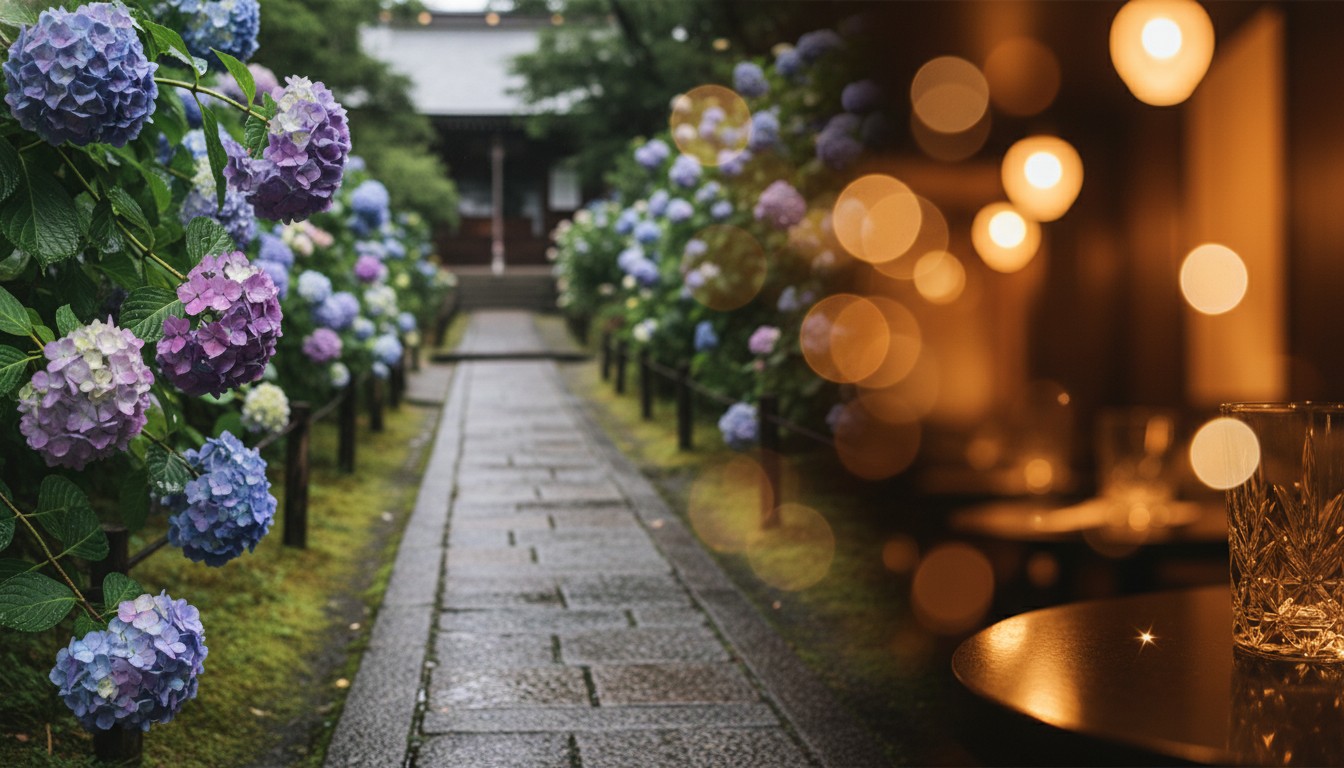
A Single Day That Holds the Best of Tokyo and the Best of Kamakura
Most travel itineraries for the Tokyo region force a false choice: temples in Kamakura or a quality evening in the city. The truth is that mid-June 2026 gives you both inside a single 24-hour day — the hydrangea (紫陽花, ajisai) bloom in Kamakura by morning and afternoon, and a calm, transparent premium evening in Shinjuku Kabukicho once the sun goes down. The trains, the timing, the weather and the seasonal off-peak nightlife all line up almost perfectly.
This guide is written for international visitors planning the 2026 hydrangea Kamakura day trip paired with a Shinjuku premium nightlife evening. It covers when the hydrangea actually peak, exactly which temples to prioritize, how to route the trains in both directions, what to wear so the same outfit works from morning hydrangea to evening lounge, and how to book your night so it's locked in before you ever leave your hotel.
For background on why June tsuyu (梅雨, rainy season) is actually the best month of the year for Tokyo nightlife, pair this with our Tokyo rainy season indoor premium nightlife guide. The two articles together give you the complete June 2026 playbook.
When Hydrangea Actually Peaks in Kamakura, 2026
Kamakura's hydrangea bloom is one of the most photographed natural events in Japan. The 2026 expected peak window is June 6 through June 18, with the very best color likely in the June 10–14 stretch. After the 18th, blooms remain visible but start to lose their saturation, and the famous "all-blue Meigetsu-in" effect fades.
Three windows worth knowing:
- Early bloom (May 30 – June 5) — Colors are coming in but not yet uniform. Smaller crowds. Acceptable if you're trip-locked to this week.
- Peak bloom (June 6 – June 18) — The reason to come. Plan around this window if at all possible.
- Late bloom (June 19 – June 25) — Still pretty, especially Meigetsu-in's later varieties. Far smaller crowds than peak weekends.
For Taiwanese travelers in particular, the Dragon Boat long weekend (June 19–21, 2026) plus 4 leave days nets a 9-day connected holiday. That window catches the tail of peak bloom and coincides with the calmest possible Shinjuku nightlife week of the year — a rare alignment we'll come back to in the booking section.
Which Kamakura Temples Are Actually Worth Your Time
Kamakura has more temples than any single day can do justice to. For hydrangea specifically, three locations matter most:
Meigetsu-in (明月院) — Universally called "Ajisai-dera" (the Hydrangea Temple) for good reason. About 2,500 hydrangea bushes, predominantly the "Meigetsu-in Blue" variety, lining stone paths through the temple grounds. The most photographed spot in all of Kamakura during June. Open 9:00 AM – 4:00 PM (extended hours during peak hydrangea season, typically 8:30 AM – 5:00 PM). Entry around ¥500.
Hasedera (長谷寺) — The second essential hydrangea temple, with about 2,500 plants planted along a winding hill path that ends at a viewpoint over Sagami Bay. Hasedera issues a numbered admission ticket during peak bloom to manage crowds — your ticket may be for an entry time 60–120 minutes later. Open 8:00 AM – 4:30 PM. Combined entry around ¥400 + ¥500 hydrangea-path ticket.
Tokei-ji (東慶寺) — A quieter alternative right next to Meigetsu-in. Smaller hydrangea display but a peaceful pre-temple walk. Worth a 20-minute stop if your Meigetsu-in entry is queued.
If you only have time for one temple, choose Meigetsu-in. If you can fit two, do Meigetsu-in in the morning and Hasedera in the afternoon — this is the natural Kamakura route and the trains support it cleanly.
The Train Routing: Tokyo → Kamakura → Shinjuku
The single most important practical detail of this entire itinerary is the train plan. Get this right and the day is effortless. The recommended sequence:
Morning leg: Tokyo (or any central hotel) → Kita-Kamakura (北鎌倉)
- From Shinjuku: JR Shōnan-Shinjuku Line direct to Kita-Kamakura, ~1 hour, ¥940
- From Tokyo Station: JR Yokosuka Line direct to Kita-Kamakura, ~55 minutes, ¥940
- From Shibuya: JR Shōnan-Shinjuku Line direct to Kita-Kamakura, ~50 minutes, ¥940
- Recommended departure: 7:30–8:30 AM to arrive at Meigetsu-in before peak crowds
Mid-day leg: Kita-Kamakura → Kamakura (鎌倉) → Hase (長谷)
- Kita-Kamakura to Kamakura: 1 stop on JR Yokosuka Line, 3 minutes, ¥150
- Kamakura to Hase: Enoden line (江ノ電), 5 minutes, ¥200 — this short ride is itself one of the most photogenic moments of the day
- Recommended timing: leave Meigetsu-in 11:30 AM – 12:30 PM
Return leg: Hase → Kamakura → Shinjuku
- Hase to Kamakura: Enoden line, 5 minutes, ¥200
- Kamakura to Shinjuku: JR Shōnan-Shinjuku Line direct, ~55 minutes, ¥940
- Recommended departure from Hase: 4:30–5:30 PM, arriving Shinjuku 5:45–6:45 PM
Total round-trip train cost: roughly ¥2,400 per person. A Suica or PASMO IC card covers everything — no paper tickets needed. If you'd rather have a single fixed-price ticket, the JR Kamakura/Enoshima Pass (¥710 from Yokohama, ¥1,640 from Shinjuku) is worth considering for two-temple days.
What to Wear for Hydrangea → Lounge in the Same Outfit
The trick of this itinerary is that you arrive in Shinjuku after a half-day outdoors, and you want to walk into a premium lounge without first going back to your hotel to change. The good news: smart-casual travel clothes work for both contexts if you choose well. Three combinations:
- Men's option — Dark chino or wool-blend trousers, a button-down or premium polo (avoid t-shirts), leather sneakers or low-profile dress shoes. Add a packable light jacket for sudden rain.
- Women's option — A midi dress, jumpsuit, or smart top with trousers/long skirt, ankle boots or closed-toe low-heels (avoid open sandals — Kamakura's temple paths get slippery, and Tokyo sidewalks splash in rain). A small cardigan handles air-conditioned interiors.
- Universal kit — Compact umbrella, small microfiber towel for hands or shoes, mosquito spray (Kamakura hydrangea gardens attract them), a slim cross-body bag rather than a backpack.
The premium lounges in Shinjuku Kabukicho do not require formal dress. They require clean, intentional, smart-casual. The same outfit that photographed well at Meigetsu-in will walk into LUXE Shinjuku looking exactly right. For details on the indoor flow, see our how-to-play page.
A Full 12-Hour Sample Itinerary
A realistic, copyable timeline for an international visitor doing both halves in one day:
- 7:00 AM — Light hotel breakfast or convenience-store coffee. Pack umbrella, towel, mosquito spray.
- 7:45 AM — Depart hotel for Shinjuku/Tokyo/Shibuya JR station.
- 8:15 AM — Board JR Shōnan-Shinjuku or Yokosuka Line to Kita-Kamakura.
- 9:15 AM — Arrive Kita-Kamakura. 4-minute walk to Meigetsu-in entrance.
- 9:30 AM – 11:30 AM — Meigetsu-in hydrangea visit. Best photo light is 9:30–10:30 before peak crowds.
- 11:45 AM — Walk back to Kita-Kamakura station. Optional 20-minute stop at Tokei-ji on the way.
- 12:00 PM — Train to Kamakura station (3 minutes).
- 12:15 PM – 1:15 PM — Lunch near Kamakura station. Options: shirasu-don (whitebait bowl) at any local restaurant, or Kamakura's famous croquettes for a lighter walking lunch.
- 1:30 PM — Enoden line from Kamakura to Hase station (5 minutes — sit on the right side for ocean glimpses).
- 1:45 PM — Arrive Hasedera. Collect your hydrangea-path admission ticket immediately, then visit the main temple and Daibutsu nearby while you wait for your timed entry.
- 3:00 PM – 4:30 PM — Hasedera hydrangea path, viewpoint over Sagami Bay.
- 4:45 PM — Enoden back to Kamakura station.
- 5:00 PM — JR Shōnan-Shinjuku Line back to Shinjuku.
- 6:00 PM — Arrive Shinjuku. Drop daypack at a station coin locker (¥400–¥700) or quick hotel-room stop if your hotel is in the Shinjuku catchment.
- 6:30 PM – 7:45 PM — Light dinner in Shinjuku (avoid heavy meals — the lounge experience usually includes drinks).
- 8:00 PM — Walk or short taxi to Kabukicho. Aim to arrive 8:15–8:25 PM.
- 8:30 PM – 10:30 PM — Premium lounge experience at LUXE Shinjuku. Standard 2-hour window.
- 10:30 PM — Settle the all-in bill (international cards accepted).
- 11:00 PM — Taxi or train back to your hotel.
That's a full, content-rich Tokyo day — temples in the morning, ocean breeze and famous bloom in the afternoon, calm city evening, and everything booked in advance so the weather never derails it.
Why This Pairing Works So Well in Tsuyu
The reason this itinerary is so highly recommended for June 2026 specifically:
- Hydrangea actively prefers moisture. Rainy days in Kamakura mean more saturated, photogenic blooms. A morning of light rain is a feature, not a bug.
- The afternoon ocean-side path at Hasedera is dramatic in any weather and stunning at golden hour.
- Shinjuku nightlife in tsuyu is at its most relaxed — fewer walk-in crowds, more attention from staff, easier reservation confirmation.
- The transition from outdoor temple → covered train → indoor evening means you spend almost no time exposed to weather you can't shelter from.
For the underlying logic of why Shinjuku evenings work so well in this season, see the Tokyo rainy season indoor premium nightlife guide.
Booking the Evening Before You Leave for Kamakura
The single rule that makes this whole day-into-night plan work: lock the evening reservation before you board the train to Kita-Kamakura in the morning. Reasons:
- You'll have no signal anxiety. Wi-Fi on Enoden trains is unreliable. Having the evening already confirmed means you can enjoy your day without checking your phone.
- You'll know your check-in time. With Meigetsu-in opening at 9 AM and Hasedera entry potentially timed, knowing your lounge slot is set for 8:30 PM lets you reverse-engineer the day cleanly.
- You'll have your address ready. If you decide to taxi from a Shinjuku-area dinner spot to Kabukicho rather than walk, the confirmation email with the venue address is already in your inbox.
To book: reserve your seat at LUXE Shinjuku — confirmation usually within a few hours, multilingual staff, transparent ¥7,000+ all-in pricing, Google 4.8★ from 310+ reviews. You can confirm pricing first if you want all details in front of you before reserving.
Avoiding the Two Common Mistakes
International visitors most often go wrong on this itinerary in two specific ways:
Mistake 1: Trying to fit a third temple. Kamakura has so many famous temples (Engaku-ji, Kencho-ji, Kotoku-in for the Daibutsu, etc.) that the temptation to add one more is constant. Don't. The Meigetsu-in + Hasedera combination is the maximum a comfortable day can absorb if you also want a relaxed Shinjuku evening. A third temple turns the day into a forced march and you'll arrive in Kabukicho exhausted.
Mistake 2: Skipping the evening reservation because "we'll decide later". This is the most common reason the evening goes wrong. By the time you arrive back in Shinjuku at 6 PM tired and hungry, walking the streets to find a venue is exactly the situation street touts (無料案内所) exploit. Pre-booking means you walk straight from station to dinner to a confirmed venue with zero risk. For deeper background on this risk, see our trust-and-safety comparison: Muryo-Annaijo vs. Transparent Booking — How International Visitors Spot Kabukicho Scams.
Budget Estimate for the Full Day
A realistic single-person budget for this day:
- Round-trip JR train Shinjuku ↔ Kita-Kamakura/Kamakura: ~¥1,880
- Enoden round-trip Kamakura ↔ Hase: ~¥400
- Meigetsu-in entry: ¥500
- Hasedera entry + hydrangea path: ¥900
- Lunch in Kamakura: ¥1,200–¥2,500
- Light dinner near Shinjuku station: ¥1,500–¥2,500
- Premium evening at LUXE Shinjuku (2-hour standard): from ¥7,000
- Taxi (optional): ¥1,800–¥2,500
- Total approximate: ¥15,000–¥20,000 per person
For a couple, double the daytime figures but the evening can be shared as a single booking with multiple seats — typically the highest-value part of the day on a per-hour basis.
For Travelers on the Dragon Boat 9-Day Window
A specific note for Taiwanese travelers: the Dragon Boat 2026 long weekend (June 19–21) plus 4 leave days extends to June 18–26, a 9-day window. Hydrangea is at the tail of its peak. Tokyo nightlife is at its lowest crowd point of the year. Reverse-direction airfares (Taiwan → Tokyo June 18, return June 26) are typically 30%+ cheaper than Golden Week or Obon. The math is unusually friendly.
A suggested 9-day shape: 2 nights at a Shinjuku-catchment hotel + 1 night in Hakone + 2 nights in Kyoto + 2 nights back in Tokyo (mid-week for Shinjuku evening) + departure. Three premium-evening slots across the trip are comfortable, especially since mid-week tsuyu evenings are the calmest of the year. For pricing context, our pricing page lays out the all-in figures so you can budget accurately.
When Not to Try This Itinerary
A few honest caveats so the expectations are right:
- If you have mobility limitations, Kamakura's temple paths involve stone steps and uneven surfaces. Hasedera in particular is built on a hill. The hydrangea-path is the most stair-heavy section of the day.
- If your trip overlaps a typhoon (台風) warning, postpone. JMA issues clear advance notice; your evening reservation can be rebooked. The Shinjuku evening alone (without Kamakura) is still a great trip-saver in bad weather.
- If the bloom forecast slips later, check the Kamakura tourism site (or the dedicated 明月院 Twitter/X account) 3–5 days before your trip. A one-week delay in bloom peak is not unusual in slow tsuyu years.
For broader trip context including the Shinjuku evening alone, see our complete Shinjuku nightlife guide for international visitors and our how-to-play page.
One Day. Two of Tokyo's Best. June 2026 Is the Window.
The hydrangea-Kamakura plus Shinjuku-Kabukicho pairing is one of those rare itineraries where everything lines up: bloom timing, train logistics, weather pattern, off-peak nightlife. If you've booked any week between June 6 and June 22, 2026, this is the single day in your trip that returns the most variety per hour invested.
Lock the evening first so the rest of the day flows easily — reserve your seat at LUXE Shinjuku and treat the temples in the morning as your reward for planning well.
FAQ — Kamakura Hydrangea + Shinjuku Evening 2026
Q: What's the peak hydrangea date in Kamakura 2026? Most likely June 10–14, with the broader window June 6–18. Late bloom remains acceptable through about June 22.
Q: Can I do this whole itinerary in one day? Yes — comfortably, if you keep it to two temples (Meigetsu-in + Hasedera) and a single evening reservation. Three temples is too much.
Q: Is the lunch in Kamakura worth slowing down for? Yes. Shirasu-don (whitebait rice bowl) is a Kamakura specialty available at most local restaurants and is far better here than anywhere in Tokyo. A 45-minute lunch fits comfortably in the schedule.
Q: Do I need to dress up for the evening if I've been temple-hopping? No. Smart-casual travel clothes work for both. Avoid t-shirts, shorts, and flip-flops. Closed-toe shoes are recommended for both the temple paths and the lounge.
Q: What if it rains heavily during the temple visit? Hydrangea actively look better in rain — saturated colors, fewer crowds, atmospheric photos. Bring a compact umbrella and don't cancel. The Shinjuku evening is fully indoor and operates regardless of weather.
Q: Can foreign residents of Japan book the evening, not just tourists? Yes. LUXE Shinjuku welcomes both visitors and foreign residents — see our FAQ for details on nationality requirements and payment methods.